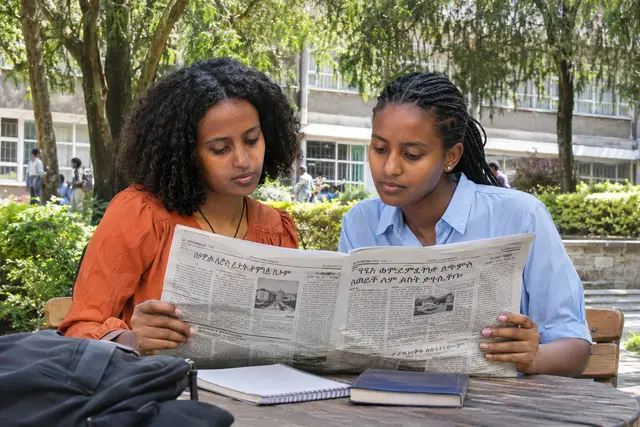
Ethiopian news media in Afar language form a small but significant part of the country's multilingual media. Afar is spoken mainly in the lowlands of north-eastern Ethiopia, in the Afar Regional State whose capital is Semera, and across the borders in Djibouti and Eritrea. News for this community reaches it chiefly through radio, regional broadcasting and a few multilingual services, while printed newspapers in Afar are rare. Documentation is thin compared with Amharic or English, so what is known rests on a handful of reference sources.
The Afar people and their language
Afar is a Cushitic language closely related to Saho and more distantly to Somali and Oromo. Its speakers are traditionally pastoralists who move with their livestock through the Danakil Depression and the Awash valley, one of the hottest and driest areas of the continent. The Afar Regional State is one of the federal regional states created in the 1990s, and its capital, Semera, is a purpose-built administrative town. Because the population is dispersed and mobility is part of the economy, news that depends on fixed addresses, such as home delivery of newspapers, has never been practical.
A literate Afar audience has also been small for much of the twentieth century. The language was written in different scripts, including Latin and Ge'ez, before a standard Latin orthography was agreed, and schooling in Afar developed gradually after the regional state was set up. These conditions explain why the language has a stronger tradition of spoken media than of printed journalism.
Radio as the main channel
Radio has been the principal medium for Afar speakers. Reference works on Ethiopian broadcasting record that the home service of Radio Ethiopia once carried programmes in several languages, with Afar among them alongside Amharic, Tigrinya, English, Arabic, French and Oromo. This was a state service, and its Afar broadcasts were mostly announcements, music and educational talks, but they made the language familiar on national airwaves.
Today the region has its own regional state media, as every Ethiopian region does, and Afar-language radio programmes continue to inform listeners about weather, livestock health, local administration and public campaigns. Battery-powered and mobile phone radios are common in pastoral areas, which suits a population that is constantly on the move. Available sources do not give the exact name, launch date or frequency of each Afar-language station, and readers who need those details should consult regional media authorities or a specialised library collection.
Multilingual services that include Afar
Some broadcasters outside the region transmit in Afar as one of several languages. A university library guide to Ethiopian news sources lists Dimtsi Weyane, the radio and satellite television service of the Tigray regional government based in Mekelle, among services that use Tigrigna, Amharic, Afar, Afaan Oromo and English. The same guide notes that its website went offline in August of 2023, which shows how quickly online access can change in a region affected by conflict.
Such cases matter because Afar communities live next to Tigray, and many Afar-speaking people follow news from both regions. Multilingual services give them regional context that a single-language outlet would not provide, even if the Afar content is only a small part of the schedule.
Print and online presence
Printed news in Afar is limited. Occasional newsletters, school materials and community publications exist, but there is no established daily or weekly Afar newspaper of the kind that exists in Amharic or English. Researchers looking for printed Afar material usually find it in the collections of universities, language institutes or non-governmental organisations that have produced bulletins on health, pastoral development or literacy.
Online, Afar content appears mainly on social networks and in video channels run by journalists and community members, including members of the diaspora in Djibouti, Europe and the Gulf. Quality and sourcing vary, and readers should look for named editors, a stated organisation and an ability to correct mistakes before treating a page as a reliable news source.
Role of regional government media
Regional governments in Ethiopia run their own media offices, which broadcast official information in local languages. In the Afar Region this role covers announcements about drought response, health campaigns, school enrolment, road projects and the regional council. These services are essential for public information but are not independent in the way a privately owned newspaper might be.
For an Afar-speaking listener, the most useful reading strategy is to treat official broadcasts as a source on what authorities say they are doing, and to look to independent or international reporting for assessments. When both agree on a fact, such as the date of a flood or the opening of a clinic, confidence in that fact rises.
Press freedom and access challenges
Journalists in lowland regions face particular practical obstacles. Distances are long, roads are limited, electricity can be unreliable and security conditions have at times restricted travel. Media in Afar must also operate within the national legal framework for press and broadcasting, and press freedom groups have repeatedly noted pressure on journalists across Ethiopia, including detentions and suspensions of outlets in several regions.
The result is that independent reporting from Afar-speaking areas is scarce. Many national newsrooms rely on visits, official statements or aid agency reports, and local-language voices are not always heard. Strengthening Afar-language media would help communities follow health, climate and political issues that concern them directly.
How to find and evaluate Afar news
A practical approach starts with a library guide to Ethiopian news outlets, which identifies services that use Afar and gives their official websites. Next, compare regional broadcasts with international services such as those of broadcasters that offer Horn of Africa programming, then check community social media pages for local detail.
Where an outlet does not say who owns it, which language it uses or how to contact its editors, treat its reporting with caution. Keep notes on the date of each broadcast, because online archives for small outlets can disappear, and save key statements if they might be needed later for research.
Language policy and education
Ethiopian federalism lets each regional state choose its own working language, and Afar is used in the Afar Region for administration and in primary schools. This policy matters for media because every child who learns to read Afar becomes a potential reader of printed or online news in the language. Teachers, literacy programmes and radio education broadcasts therefore form a hidden foundation under any future growth of Afar journalism.
Writers face practical tasks that older languages of print solved long ago: agreeing spellings for new words about technology and politics, finding translators for official texts, and training editors who can work comfortably in both Afar and a national language. Each of these tasks affects how quickly an Afar-language newspaper or website could become sustainable.
Cross-border audiences
Afar speakers live in three countries, so news in the language does not stop at the Ethiopian border. Listeners in the Ethiopian lowlands can also tune in to services from Djibouti and Eritrea, and diaspora communities link the three territories through telephone calls and social media. Developments such as trade through the port corridor, pastoral migration or regional security can therefore be discussed across borders in the same language.
This cross-border dimension is both an opportunity and a challenge for Ethiopian outlets. It widens the potential audience, but it also means that Ethiopian broadcasters compete with foreign stations whose editorial priorities differ and whose coverage of Ethiopian affairs may be limited or highly selective.
Place in the Ethiopian media landscape
Within the wider Ethiopian press, Afar-language media sit among the smaller regional-language services, far behind the Amharic, English and Afaan Oromo outlets in volume. Yet their existence reflects an important principle: that people in lowland, pastoral regions deserve public information in a language they understand. For researchers of Ethiopian media, the Afar case is a reminder that a count of newspapers alone gives a poor picture of how news travels, because much of it moves by voice, radio and mobile phone rather than by print.