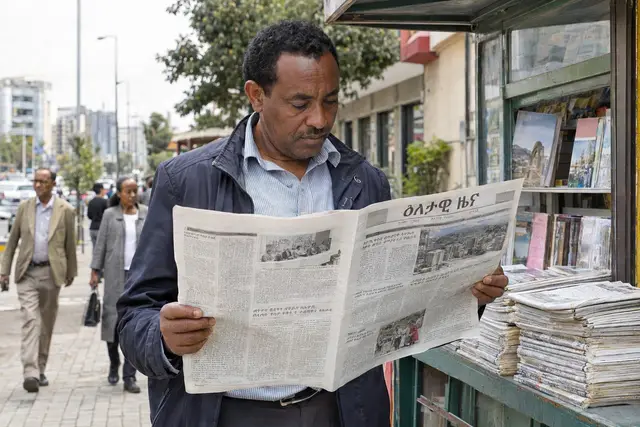
Ethiopian newspapers in Tigrinya language are the periodicals and news services that report in the Semitic language of the Tigrayan and Eritrean peoples, written in the Ge'ez script. Printed titles are fewer than in Amharic, and published sources give little on circulation, so much of the news reaches readers through radio, news agency websites, regional broadcasters and online outlets based in Mekelle, Addis Ababa and the diaspora. The press is closely tied to regional politics and was heavily disrupted by the conflict that began in 2020.
Tigrinya and its readers
Tigrinya is a Semitic language written in the Ge'ez script, the same family of letters used for Amharic. It is spoken mainly in the Tigray region of northern Ethiopia and, across the border, in Eritrea, where it is one of the most widely used languages. Tigrinya speakers also live in large numbers abroad, in Sudan, the Gulf, Europe and North America, so a reader of the language may be anywhere.
Because the language is shared by two countries with a difficult recent history, its press is hard to separate from politics. A title published in Mekelle, in Asmara or in a diaspora city represents a different editorial position, and a reader benefits from knowing which one is in hand.
Early Tigrinya printing
The African Language Materials Archive names two early Tigrinya publications, Nay Eritrea Semonawi Gazeta and Hanti Eritrea, which belong to the Eritrean press of the twentieth century. Their titles point to Eritrea, which means that early Tigrinya printing is linked to that country as much as to the Ethiopian highlands.
In Ethiopia itself, Amharic dominated state publishing for most of the century, and Tigrinya appeared more in broadcasting and in small publications of the regional administration and of political organisations. The language became a medium of regional administration and education only after the political changes of the early 1990s.
Regional media in Tigray
The most prominent Tigrinya media outlet in Ethiopia has been Dimtsi Weyane, based in Mekelle. It began in 1980 as a radio station run by the Tigrayan People's Liberation Front during its fight against the Derg regime, and it added satellite television in 2018. Its programming was mainly in Tigrinya, with some content in Amharic, Oromo and English.
Reports in 2020 indicated that Dimtsi Weyane and the regional television service stopped broadcasting around July of that year, and the cause was not publicly confirmed by the authorities. Tigrai TV and Tigray Media House are other names that appear in discussions of regional broadcasting. The situation since then has changed several times, and readers should consult current sources before assuming that any channel is on air.
Print titles and newsletters
Information on printed Tigrinya newspapers inside Ethiopia is limited in the sources consulted. Regional government offices, universities such as Mekelle University and religious institutions publish bulletins and magazines in the language, but complete records of founding dates and circulation are not readily available.
This lack of documentation is common for regional-language periodicals. Many circulated in small print runs, were distributed by hand or through local shops, and were not catalogued by national libraries. Researchers who need a specific title often have to ask the publisher or search in university collections.
The role of broadcasting and online news
Radio has been the strongest medium for Tigrinya in Ethiopia. The Ethiopian News Agency publishes a Tigrinya edition of its website, Fana Media Corporation offers news in Tigrigna, and regional services in Tigray broadcast in the language. Online, sites such as Tigrai Online, listed in the Stanford Libraries guide to Ethiopian news, aggregate reports for readers abroad.
Social media is now the main channel for many young readers. Messages, voice notes and videos in Tigrinya circulate through messaging applications, and short posts often replace the printed bulletin that used to be pinned to a wall.
Conflict, blackout and media
The armed conflict in Tigray that began in November 2020 brought telephone and internet shutdowns, restrictions on journalists and the displacement of many residents. For a time, reporting in and about the region depended on exiles, humanitarian workers and a few journalists with access, and the flow of local-language news was severely disrupted.
The consequences for the media continue to be debated. Rebuilding newsrooms, training reporters and restoring archives are tasks for regional institutions, and readers should be cautious about unverified claims that spread during and after the conflict.
Eritrean Tigrinya media next door
Eritrea has its own Tigrinya press, led by state-run outlets published in Asmara, among them the newspaper Hadas Ertra. Eritrean media operate under tight state control, and independent reporting from inside the country is rare.
For readers in Ethiopia, Eritrean titles provide a view of the neighbour's official line but are not interchangeable with Ethiopian sources. Diaspora media from Eritrea and Tigray add further voices, and the variety of dialect and spelling between the two countries can surprise new readers.
Reading Tigrinya news as a learner
The Ge'ez script has well over two hundred characters, each representing a consonant with a vowel, and learners often begin with a chart of the basic forms. News items use a limited vocabulary, so short articles about weather, markets or sport make good practice material.
Reading aloud is useful, and comparing a Tigrinya item with an English or Amharic report on the same event helps to identify words. Because many online posts use inconsistent spelling, printed or edited sources provide a safer model.
Religion, schools and the language of daily life
Tigrinya is the language of church and school in many communities. Orthodox Christian services use Ge'ez for liturgy and Tigrinya for sermons, and religious newsletters and calendars circulate in the language. Schools in Tigray teach in Tigrinya in the early grades, which creates a steady demand for reading material of all kinds.
Weddings, funerals, fasting seasons and holidays structure the year, and news about them, from announcements to reports of ceremonies, is a staple of community media. Poetry and songs in Tigrinya, often connected with the history of the region, appear in radio programmes and printed collections.
Diaspora publishing
Large communities of Tigrinya speakers abroad keep their own newspapers, websites and radio programmes. They report on events at home, publish opinion pieces and organise cultural events. Their editorial lines range from strongly political to cultural and religious.
Distribution is largely digital, and a reader in Europe or North America may follow a Tigrinya outlet without ever seeing it in print. This spreads the language beyond its home region but also raises questions about funding, editorial independence and the reliability of information from distant sources.
Translation between Tigrinya, Amharic and English
News organisations that publish in several languages translate rather than rewrite. A story prepared in Amharic or English is rendered into Tigrinya for a regional edition, and in this process nuance can be lost, particularly with technical terms in law, economics and health. Translators coin or borrow words, and different outlets may choose different forms.
A reader who compares versions of one news item in two languages can see these choices. The comparison is also a practical way to learn which vocabulary has become standard in the written language and which terms are still contested.
Finding sources and verifying them
Start with the websites of established agencies and broadcasters that publish in Tigrinya, then look for university and library resources. When using social media, check who posts, when the item was posted and whether other sources confirm it.
For research, the best practice is to cite the title, the date and the place of publication, and to note whether the outlet belongs to a government, a party, an association or a private owner. This allows a reader to weigh the information properly.