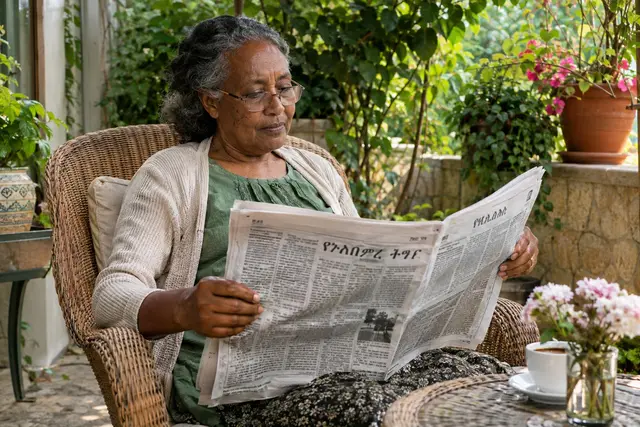
The Ethiopian Herald is a state-owned English-language newspaper of Ethiopia, produced in Addis Ababa by the Ethiopian Press Agency. It first appeared in 1943 as a weekly and later became a daily that is issued every day except Monday. Its readers include diplomats, teachers, students, civil servants and foreign residents who want Ethiopian news in English. As a public-sector title it carries official announcements and development reporting, and it sits beside Amharic and other language papers published by the same agency.
Origins in the 1940s
Its first issue came out on 3 July 1943, in Addis Ababa. That was only two years after the restoration of Emperor Haile Selassie's government following the Italian occupation, a time when the state was rebuilding its administration, schools and communications. An English-language newspaper served several practical purposes in those years. It gave the government a channel to explain its policies to foreign embassies and missions, it offered English readers in the capital a regular source of local news, and it supported the teaching of English, which was becoming the language of secondary and higher education.
Reference sources describe an Englishman as its first editor, which was typical of the period, when foreign advisers and journalists were common in Ethiopian institutions. Beyond these basic facts, the available sources consulted do not give detailed accounts of its first print runs or staff, and accurate statements about early circulation are not available.
Publisher and ownership
The Herald is published by the Ethiopian Press Agency, a public media enterprise in Addis Ababa. A university library guide dates the agency to 1940 and says that it publishes in Amharic, English, Afaan Oromo and Arabic. The agency also issues the Amharic daily Addis Zemen, which is widely regarded as the national-language counterpart of the Herald, and other papers aimed at different language communities.
Because the owner is the state, the Herald is described in reference works as government-owned. This status shapes its editorial role. It is a vehicle for official information, development news and policy explanation, and it is less likely than a private weekly to pursue investigations of ministers or state companies. Readers who want to understand how the authorities present events will find it useful, while readers who need independent scrutiny will usually combine it with private publications.
Frequency and format
Publication runs six days a week, with no Monday issue. This rhythm gives it the density of a national newspaper: current news in the front section, longer features and commentary inside, and pages devoted to sport, culture and notices. Its layout follows the conventions of English-language dailies, with a lead story, photographs and advertisements on the front pages.
The agency's own web platform is listed in the Stanford library guide at press.et, where the English stories are one of several sections. When that address was opened for verification it displayed only a technical error message and a reload link, so readers who cannot get the web edition should try again later or consult library holdings for the printed paper.
Content and sections
The Herald's content centres on national affairs: federal government decisions, parliament, regional development, agriculture, health, education, infrastructure and diplomacy. Its coverage of African Union and United Nations meetings in Addis Ababa gives it a regional dimension, since the city hosts the headquarters of the African Union and the United Nations Economic Commission for Africa.
Typical content also includes editorials that explain the government's position, columns on social topics, letters from readers, business and economy pages, cultural notes and sport results. Like many state dailies, it also carries government tenders, vacancies and public notices, which for some readers are the main reason to buy it.
Readers and language
English is not the mother tongue of most Ethiopians, so the Herald addresses a particular segment of society: people educated in English, who work in government, education, commerce, non-governmental organisations and diplomacy. Its audience also includes learners, since many teachers use English newspapers in classrooms to teach vocabulary and reading.
The paper's English follows a formal journalistic style with an emphasis on official terminology. Readers abroad, including diaspora members and researchers, use it to read how Ethiopian institutions describe their activities. Because there is a limited number of English dailies in the country, the Herald holds a distinctive place among English-language media.
Historical archive and research value
Back issues of the Herald are a valuable source for historians of modern Ethiopia, because a government daily records official language, appointments, speeches and policy campaigns over decades. Researchers studying imperial, military-era and federal-era Ethiopia can compare how successive governments used the paper.
Archives of Ethiopian newspapers are held in national and university libraries, and some institutions abroad maintain collections of the English-language press. Digitisation is uneven, so researchers often need to consult microfilm or paper volumes. A library guide to Ethiopian newspapers is the best starting point for locating holdings.
Place in the Ethiopian media landscape
Ethiopia's English-language press includes state titles such as the Herald and private weeklies such as Addis Fortune, Capital and The Reporter. The Herald stands out as the state-owned title among them, and it is often paired in discussions with its Amharic sister paper. Private weeklies provide critique and analysis, while the Herald supplies the official record and a steady stream of routine news.
Press freedom organisations describe an environment in which state media dominate broadcasting and the private press operates under legal and economic pressure. In that environment, a daily like the Herald offers continuity and institutional memory, but readers should understand it as a public-sector voice and look to other outlets for independent perspectives.
How to read and cite it
When quoting the Herald, researchers should record the date of the issue, the headline and the author or desk where one is named, and should state that the paper is owned by the Ethiopian Press Agency. Comparing a Herald report with coverage in a private weekly or an international service helps place the information in context.
For general readers, a short daily routine works well: read the front page for official announcements, the business page for economic indicators and the editorial page for the government's argument, then check a private source on any controversial matter.
Daily rhythm of a state newspaper
A government daily follows the calendar of public life. Mondays are skipped in the Herald's schedule, so the Tuesday issue typically gathers developments from the weekend and the first working day of the week. Parliamentary sessions, ministerial press conferences, inaugurations of roads, schools and clinics, and the national holidays of the Ethiopian calendar shape the news agenda far more than breaking incidents do.
This calendar-driven style explains why the paper is often read for context rather than surprises. Anyone who wants to know what policy themes the authorities emphasised in a given month can follow the Herald's recurring headlines on agriculture, industrial parks, health extension work or regional cooperation, and then check them against independent reports.
Working with the paper as a language resource
Teachers and students of English in Ethiopia have long treated newspapers as a free textbook. The Herald's clear, formal sentences, its stable vocabulary for politics and economics and its regular editorials make it suited to classroom exercises on summarising, vocabulary building and writing letters to the editor. Translators also read it to find the standard English renderings of Amharic institutional names, ministries and programmes.
For foreign researchers the same feature is useful in reverse: the paper shows how Ethiopian official terms are officially rendered in English, which helps avoid inconsistent translations in academic work.