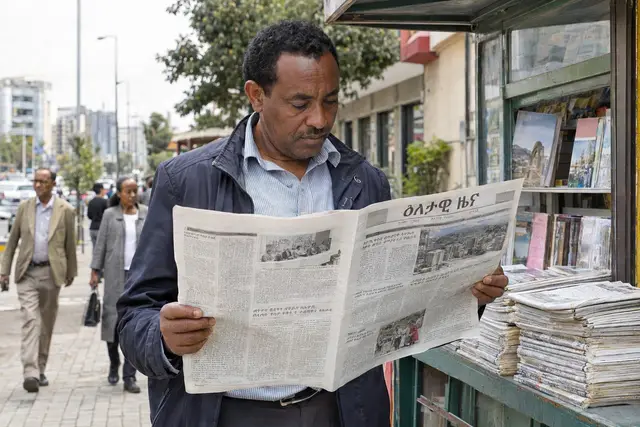
Ethiopian Observer is an English-language online magazine about Ethiopia, usually listed under the name Ethiopia Observer. It describes itself as a reliable, diverse and insightful voice on Ethiopia, dedicated to telling stories about Ethiopian politics, culture and history. Its pages are mostly in English, with some headlines and articles in Amharic script, and its archive reaches back to 2013. It has no named owner on its home page. The site is organised into news and politics, opinion, lifestyle, media, profiles and arts, which gives it the shape of a general magazine.
Name and identity
The title appears in two forms. A university library guide lists the outlet as Ethiopia Observer, in English, at the address ethiopiaobserver.com, and the site itself uses the same name. The form Ethiopian Observer is a variant and refers to the same magazine here. Naming differences of this kind are common in online media and can make searches harder, so researchers should note both forms when looking for citations.
The magazine's statement of purpose is short and promises stories on politics, culture and history. That wording points to a general-interest cultural and political magazine rather than a breaking-news service.
Ownership and editors
The pages consulted do not name an owner, publisher or editor, and the footer gives only a copyright line with the name of the magazine. The library guide that lists it likewise gives no publisher. Without this information, it is not possible to describe its funding or editorial structure with confidence.
Careful readers can compensate by checking bylines on individual articles, noting whether authors identify their affiliations, and comparing important claims with other sources. Where an outlet is transparent about authors and corrections, trust increases.
Sections and structure
The site is organised around several headings. News and Politics includes subsections for politics and the economy. Opinion hosts commentary. Lifestyle includes Travel. Media has subsections on Newspaper, TV and Radio. Profile includes obituaries. Arts and Culture covers photography, books and a Poetry Corner.
This list reveals an editorial orientation toward culture and society as much as toward political news. The Media section is of special interest to students of the press, as it brings together items about newspapers, television and radio in Ethiopia.
Language mix
The magazine is written mostly in English, which gives it an international and diaspora readership. Some headlines and articles appear in Amharic script, which indicates an effort to serve readers who prefer the national language or to quote sources in their original wording.
For English readers, this mix gives a taste of the bilingual character of Ethiopian public life, and for researchers it provides examples of how terms and names are used in both languages.
Archive and longevity
The home page shows items from many years, and the archive begins in 2013. A run of more than a decade makes the site useful as a record of public events, cultural debates and obituaries. Long-running online archives are valuable but fragile: pages move, plug-ins break and sites can be redesigned without preserving old addresses.
Readers who cite older articles should save a copy or use a web archive and record the retrieval date.
Profiles, obituaries and cultural memory
A Profile section with obituaries is an uncommon feature among online news sites and reveals a concern with cultural memory. Obituaries of writers, musicians, scholars, athletes and public servants document lives that would otherwise be difficult to trace in written sources, especially in English.
Together with the Poetry Corner and book pages, these items make the magazine a resource for students of Ethiopian literature and social history.
Media coverage inside the magazine
The Media heading brings the press itself into the picture. Items about newspapers, television and radio help readers follow developments such as the launch of a channel, a change in editorial leadership or a press freedom incident. Because the magazine reports on media, it is itself part of the discussion on the state of Ethiopian journalism.
When using this material, a reader should look for original sources for any claim about closures or legal action, as secondary summaries can simplify complicated cases.
Place in the Ethiopian media landscape
Ethiopia Observer sits among digital outlets that combine news and culture, such as Addis Standard for analysis, Ethiopian Monitor for daily news and New Business Ethiopia for markets. Its distinctive trait is the presence of arts, literature and obituaries beside politics, which gives it the tone of a magazine rather than a news ticker.
Private weeklies such as Addis Fortune and The Reporter publish in print as well as online, while this magazine exists mainly as a website, which makes it accessible abroad but dependent on internet access at home.
Press freedom and digital context
Online magazines in Ethiopia operate within the laws on media and communications, and press freedom groups have reported restrictions on internet access and pressure on journalists during tense periods. Opinion websites are not immune: commentary on political subjects can attract complaints, and writers may exercise caution.
A magazine that carries signed opinion and obituaries needs editorial care to separate fact from tribute and from argument. Readers can look at labels and bylines to tell the difference.
How to read and cite it
Cite the author, title, section, date and web address. For political claims, compare the report with at least one government source and one independent source. For cultural items, such as book reviews or profiles, check names and dates against other references.
If an article is in Amharic script, note the language, and quote the original text when accuracy matters.
Writing about Ethiopian history
History is one of the three pillars in the magazine's statement of purpose, and it matters in a country where the past is constantly invoked in political debate. Essays on emperors, wars, the imperial and military-era governments, the federal constitution and the achievements of Ethiopian scholars give readers background that daily news rarely supplies.
Historical writing in an online magazine varies in rigor, and readers should look for references, named archives and dates. An essay that quotes documents and gives sources can be useful to students, while one that offers only opinion should be read as commentary.
Travel and lifestyle
The Lifestyle heading, with its Travel subsection, extends the magazine beyond politics. Accounts of journeys to the rock-hewn churches of Lalibela, the highlands of Simien, the Omo valley or the city of Harar attract readers who may never have visited the country but who want to learn about it. Foodways, coffee culture and festivals are typical subjects.
Such material has a double value. For foreign readers it gives a human portrait of Ethiopia, and for Ethiopians in the diaspora it keeps links to home through familiar places and customs.
Photography, books and poetry
The arts pages mention photography, books and a Poetry Corner. Photography is especially valuable as documentary evidence of street life, buildings and ceremonies, and the best online photo features include captions with the place and date. Book pages introduce new works by Ethiopian authors and studies of Ethiopian subjects, and a poetry corner offers a space for verse, a form with deep roots in Ethiopian oral and written traditions.
For researchers in literature, these pages provide a trace of contemporary reception: which books were noticed, who reviewed them and how they were described.
Audience and diaspora links
Much of the readership likely consists of Ethiopians abroad and foreign readers interested in the country, since an English-language site with Amharic fragments appeals to both. Diaspora readers often seek a mix of political news, cultural pieces and obituaries that connect them to events at home.
The same audience participates through comments and social media, which in turn shape the choice of topics. Editors of such sites usually watch which articles are shared most and may adapt their programme accordingly.