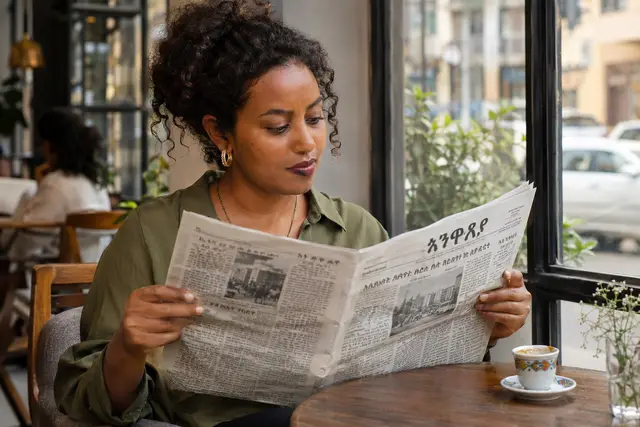
Ethiopian newspapers in Afaan Oromo are the print and online periodicals that report news and culture in the language of the Oromo, the largest community in the country. The best-known title is Bariisaa, a weekly issued in the capital, Addis Ababa, by the Ethiopian Press Agency, while Yeroo has appeared in Afaan Oromo and English. Publishing in the language developed from the 1960s and expanded after the adoption of the Latin-based Qubee alphabet, and broadcasting often reaches more people than print.
Oromo as a language of the press
Afaan Oromo is spoken by the largest linguistic community in Ethiopia and is also used in parts of Kenya. Its written press is young compared with that of Amharic. The African Language Materials Archive notes that publication in Afaan Oromo began in the 1960s, long after Amharic periodicals had been established in the first half of the twentieth century.
For many decades, writing in the language was constrained by policy and by script. Early printed material used Ethiopic letters or other adaptations, and the move to a Latin-based alphabet known as Qubee in the early 1990s made printing simpler and the language easier to teach in schools. This change opened the way to a larger flow of books, magazines and papers.
Bariisaa and the state press
The best-known title is Bariisaa, an Afaan Oromo weekly published in Addis Ababa by the Ethiopian Press Agency, the same federal body that issues the Ethiopian Herald, Addis Zemen and the Arabic weekly Al-Alem. A scholarly article published by Haramaya University journals examines how Bariisaa figured in debates on Oromo identity and rights during the Derg period, which shows that the title has a long history.
As a state paper, Bariisaa carries official announcements, development news, cultural features and articles on language and literature. For researchers it offers a continuous record from a government perspective, and it should be read alongside independent sources.
Yeroo and other titles
Another title mentioned in lists of Ethiopian newspapers is Yeroo, which appears in Afaan Oromo and English and is recorded with publication periods of 1999 to 2000 and again from 2018. The interruption shows how fragile the sector has been, with titles starting, stopping and returning when conditions allow.
Regional administration of Oromia publishes its own material, and cultural organisations and universities issue newsletters and journals in the language. Magazines on culture, children's learning and religion circulate in smaller numbers. Information about circulation, founding dates and ownership for such outlets is often incomplete, and available sources do not always give it.
Broadcast and online media in Afaan Oromo
Radio and television play a stronger role than print. The Ethiopian Broadcasting Corporation operates a version of its website in Afan Oromo, the Ethiopian News Agency publishes in Afaan Oromoo, and Fana Media Corporation offers news pages in the language. Regional broadcasting services in Oromia provide programmes in Afaan Oromo for local audiences.
Diaspora media have also been prominent. Oromia Media Network, based outside Ethiopia, has been among the best-known channels, and the Stanford Libraries guide lists Oromia Media and Oromia Public Media among sources on the region. Websites and social media pages carry news and commentary, and some began as local newsletters.
Language standardisation and education
The press and the school system have grown together. Once Afaan Oromo became a language of instruction in primary education in the Oromia region, demand for reading material rose, and newspapers offered adults and pupils a place to see the written language in daily use. Teachers use cut-out articles to illustrate grammar and vocabulary.
Spelling issues remain. Words borrowed from Amharic, English and Arabic are written in several ways, and editors have to choose between forms. Universities and language academies work on dictionaries and style guides, and newspapers apply their decisions in practice, which helps standardise the written language across the region.
Women, youth and cultural voices
Magazines and newspaper pages aimed at women and young people discuss health, education, work and family life. Young writers who publish poems and short stories in the press gain a first audience before they publish books, and radio programmes often read such texts aloud.
Cultural festivals, such as the Irreecha thanksgiving ceremony, and traditional ceremonies feature in photo reports. Coverage is valued by readers who want to see their traditions recorded in a lasting form.
Readers and distribution
The readership is spread across the Oromia region, the capital and other regions where Oromo communities live. Distribution of printed papers is strongest in Addis Ababa and in major towns such as Adama, Jimma and Nekemte, while villages rely mostly on radio and on word of mouth.
Students form an important group, since Afaan Oromo is a medium of instruction in schools of the region and a subject at universities. They read the press to improve their writing and to follow public debate in their language.
Topics that appear in the press
Oromo-language papers cover local government decisions, agriculture, coffee and livestock markets, education, health, culture and sport. Features present Gadaa, the traditional system of governance, folklore, proverbs, poetry and music, and they often introduce writers and artists to a wider audience.
Language itself is a topic. Articles discuss spelling, vocabulary for new technologies and the role of Afaan Oromo as a federal working language. Debates about the use of Finfinne as the Oromo name for the capital show how names carry identity.
Press freedom and political context
Oromo media has operated in a politically sensitive environment. Over the years, journalists and outlets associated with Oromo issues have faced restrictions, and some media have been closed or relocated abroad. The Committee to Protect Journalists and other organisations have documented cases involving journalists in Ethiopia, including during periods of protest and internet shutdown.
Readers should know who owns a title and where it is based. State papers reflect official positions, regional outlets reflect local administrations, and diaspora channels often reflect political currents. Comparing several sources is the best way to evaluate a claim.
Finding and reading Afaan Oromo papers
Printed issues of Bariisaa can be bought in Addis Ababa at newsstands that sell Ethiopian Press Agency titles. Online access is more variable, and a reader who cannot find a current issue should check the agency's channels and the websites of broadcasters that provide news in the language.
Learners of the language benefit from reading short news items with a dictionary. Latin letters make Afaan Oromo easier for beginners from outside Ethiopia, and the repeated vocabulary of news about weather, markets and politics offers a practical introduction.
Radio and the oral tradition
Afaan Oromo has a rich oral tradition of proverbs, songs and praise poetry, and this heritage explains why radio suits the language so well. A newsreader's voice, repeated phrases and storytelling formats connect easily with listeners who grew up with spoken literature. Many written stories in the press began as pieces first told aloud.
The strength of oral culture also affects how newspapers write. Short sentences, direct quotations and expressions taken from everyday speech make articles easy to read aloud in a group, a habit that is common in places where not everyone reads.
Archives and research
Researchers can find early material in library collections, in university archives such as those in Addis Ababa, and in published studies on Ethiopian media history. The ALMA resource on African language newspapers is a starting point to understand the context, though it gives no list of Oromo titles.
Studies on Bariisaa and on language policy supply analysis that complements the papers themselves. For any title, it is useful to note the date, the publisher and the script, since conventions have changed over time.