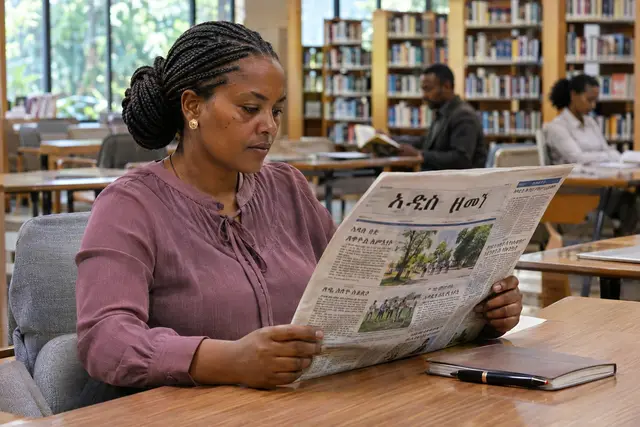
Addis Standard is an independent Ethiopia news magazine that now works mainly as a digital outlet, founded in Addis Ababa in February 2011 by the journalist Tsedale Lemma. It is published by JAKENN Publishing and appears in English, with Amharic and Afaan Oromo services added later. The title began as a monthly print magazine and became known for political reporting, analysis and long-form coverage of conflict and rights. Its history includes the end of print distribution, a regulatory suspension that was later withdrawn, and further official action.
Founding as a monthly magazine
Addis Standard was founded in February 2011 by Tsedale Lemma, who started it as a monthly English-language magazine rather than a weekly newspaper. That choice mattered. A monthly could not compete with dailies on speed, so it concentrated on explanation: longer features, interviews, analysis of laws and policies, and photography. The format appealed to readers in the diplomatic, academic and development communities who wanted context more than headlines.
Its publisher is JAKENN Publishing P.L.C., an Addis Ababa company named in a university library guide to Ethiopian news sources. The guide lists the magazine as English-language and monthly, with 2011 as its founding year, and gives the web address addisstandard.com.
Ending the print edition
Reference works record that the print edition was discontinued in October 2016, in response to what the publisher described as censorship, while the online edition continued. The decision illustrates a pattern in Ethiopian media: when printing and distribution are exposed to administrative pressure, publishers may shift to the internet, where reach is smaller in Ethiopia but larger abroad.
From that point the outlet is best described as a digital news magazine. It kept the habits of a magazine, with signed analysis and longer reports, while adopting the rhythm of a website that publishes new items regularly.
Languages and services
The magazine's own announcement refers to a tri-lingual service launched by its publisher, covering Amharic, Afaan Oromo and English. Adding the two national languages expanded the potential audience beyond English readers and followed an editorial logic: Afaan Oromo and Amharic are the most widely used languages in Ethiopia, and English-only coverage left most citizens outside the readership.
Translation also introduces editorial challenges, such as consistency of terms and the speed at which stories can be adapted. Readers who compare the versions may find differences in length or emphasis, and the English text remains the main reference for international users.
Editorial leadership and character
Tsedale Lemma, the founder, has been editor-in-chief since January 2021 according to reference sources, and she has appeared in international media as a spokesperson on press freedom in Ethiopia. The outlet is known for reporting that touches sensitive subjects such as security operations, political prisoners, elections, parliament and humanitarian conditions.
The website's home page shows how this works in practice: previews of articles about earthquakes near Addis Ababa, fighting in northern Shewa, reports of forced conscription in Oromia, legislation carried over in parliament, and economic slowdown in the Merkato market. The mix includes both hard news and social reporting.
Regulatory pressure and suspension
In July 2021 the media regulator suspended the outlet, and the government later withdrew the suspension. Press freedom groups used the episode to illustrate the fragile position of independent media. Later reports describe further regulatory action and difficulties facing its staff, and because the situation may change, readers should check recent news about its legal status rather than rely on any static description.
This continuing pressure explains why the magazine is often cited in reports on press freedom in Ethiopia. It is both a source of news and a subject of news, which should be kept in mind when evaluating coverage of media topics by the outlet itself.
Place among Ethiopian news outlets
Addis Standard occupies a niche between daily newspapers and academic journals. Unlike Addis Fortune or Capital, it is not a business weekly, and unlike The Reporter it started as a monthly rather than a weekly. Its analytic style resembles that of international magazines, while its subject matter is rooted in Ethiopian politics and society.
Researchers often cite it as an English-language source for political developments, particularly in periods when other outlets were restricted. Because it is independent of government and party structures, it is also read by analysts who compare it with state media.
Digital access and reading habits
As a digital outlet, the magazine depends on web traffic, social media distribution, grants and advertising. Readers reach it through its website, search results and social networks. Content is generally accessible online, which makes it practical for researchers abroad, but access within Ethiopia can be affected by internet interruptions and by the high cost of data.
A good reading habit is to check the date of every item and to look for updates, since stories on security or politics can change quickly and later articles may correct earlier ones.
How to verify and cite it
Cite the article title, author where given, date and web address. For claims about security or politics, compare Addis Standard with government sources, other private media and international organisations. If a report relies on anonymous sources, note that limitation. Where a figure is given for casualties or displacement, check whether the outlet attributes it to a named agency.
Treat the magazine's own press freedom reporting with the same care: it is valuable first-hand testimony, but it comes from a party directly concerned.
Why a magazine format suits Ethiopian politics
Political life in Ethiopia moves through federal and regional institutions, party platforms, constitutional debates and negotiations among ethnic and regional communities. A daily report on any single event can leave out the background that readers need. The magazine format gives room for that background: how a law was drafted, which actors support it, what earlier policy it replaces and what legal commentators expect.
The same format fits subjects that need patient documentation, such as displacement, land disputes or the work of commissions of inquiry. Readers who study these topics can use a series of reports to follow developments over several months instead of piecing together separate news flashes.
Women, rights and social themes
A news magazine led by a woman editor has drawn attention in a field that remains largely male in Ethiopia. Beyond that fact, the outlet's coverage has included social subjects such as gender, civic space, access to justice and public health. These themes appear alongside politics, and they add to its profile as a general-interest magazine rather than a purely political outlet.
For researchers on civil society and human rights, such reports are a record of the questions that activists and professionals were raising at particular moments.
Photography and presentation
Addis Standard began as a printed magazine, and the web edition keeps images central to its reports, with photo credits attached to pictures of parliament, markets and public events. Careful captions identify date and place, which helps readers and archivists verify the context of an image.
Visual quality is a practical consideration for a digital outlet, because pages with strong images are more likely to be shared on social networks, which in turn brings new readers to the reporting.
Relationship with its audience
The outlet relies on readers who value independent English-language reporting. Many of them live outside Ethiopia, including researchers, humanitarian workers, journalists and members of the diaspora. Inside the country, readers with reliable internet access follow it on mobile devices and through social platforms.
Direct engagement through newsletters, comments and social posts allows the editors to measure which subjects interest readers. This feedback loop can improve service, but it can also encourage a focus on controversial headlines, which is a risk for any digital outlet.
Using it in research and teaching
Teachers of journalism and political science can use the magazine to show how analysis differs from news and how editorial independence is tested. Students can compare a story from Addis Standard with the same story in the Ethiopian Herald and in a private weekly, noting differences in sourcing, vocabulary and the people quoted.
For librarians, the digital archive raises the issue of preservation: websites change, articles are edited or removed, and a cited page may disappear. Saving a dated copy of an important article is therefore a prudent habit.