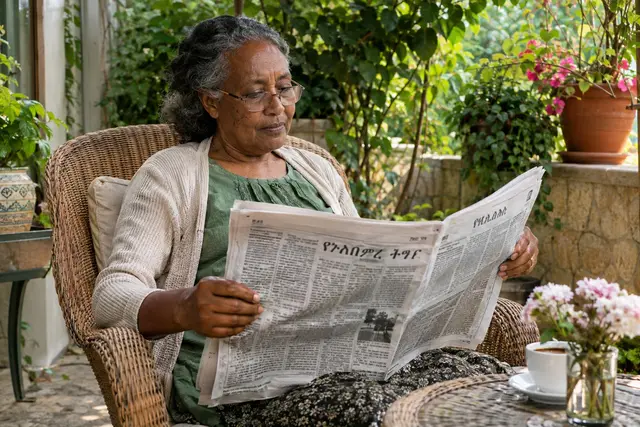
Democracia is a historical newspaper in Ethiopia, the official organ of the Ethiopian People's Revolutionary Party, written in Amharic. It was launched in July 1974, when the party's Central Committee returned from exile, and began as a clandestine weekly later printed in Addis Ababa under tight security control. Historians describe it as the most avidly read publication in Ethiopia's history. The sources consulted do not say when it ceased to appear, and it survives only in scattered copies and citations.
Birth during the revolution of 1974
Democracia first appeared in July 1974, when the Central Committee of the Ethiopian People's Revolutionary Party returned to the country from exile. The timing was dramatic. Strikes by teachers, taxi drivers and soldiers had weakened the imperial government earlier in the year, and in September 1974 Emperor Haile Selassie was deposed by the military committee known as the Derg.
The party chose a weekly newspaper as its main tool of mass communication. It was first distributed in secret, and then printed in Addis Ababa itself despite the control of the security services. Historians of Ethiopia describe a cat-and-mouse game in which copies were produced in hiding and passed from hand to hand at schools, factories and markets.
The title, Democracia, means democracy, and its Amharic form is ዴሞክራሲያ. The name stated the party's central demand: a civilian, popular government in place of military rule.
The party behind the paper
The Ethiopian People's Revolutionary Party grew out of the student movement of the late 1960s and early 1970s, which had campaigned for land reform under the slogan that the land belongs to the tiller. Many of its leaders had studied in Europe and North America before returning to organise at home.
Democracia was the party's official organ. Its articles explained the party line, criticised the Derg and called for the creation of a people's government. Other publications of the movement circulated in parallel, including the journal Abyot, which appears in archives of the Ethiopian left.
A newspaper that speaks for a political organisation differs from an independent paper. Its purpose is mobilisation, not neutral reporting, and its writers expected readers to act on what they read.
Language and readership
The paper was published in Amharic, the language of administration and of the capital, which allowed it to reach students, civil servants, teachers and urban workers. Its simple, direct style made political arguments accessible to people with limited schooling.
The historians John Markakis and Michael Waller, in a judgement often repeated, ranked it first among Ethiopian publications by the eagerness of its readers. That verdict reflects the unusual hunger for political information in 1974 and 1975, when most legal media were controlled by the state and the public sought alternatives.
Readership was shared far beyond the number of printed copies. A single issue might be read aloud in a tea house or copied by hand, a common practice in political movements working under restrictions.
Conflict with the Derg
After the Derg consolidated power, it banned political organisations that did not follow its line and treated the party as an enemy. The newspaper's clandestine distribution became more dangerous. From 1977 the confrontation between the Derg and the party escalated into the violence known as the Red Terror, in which thousands of young people were killed or detained in Addis Ababa and other towns.
The sources consulted do not give the date on which Democracia stopped appearing, and the account of its end is therefore left open. What is documented is that the paper arose in 1974 and became the voice of an organisation that the state later set out to destroy.
Surviving copies are therefore rare, and many of the people who produced them were killed or exiled.
Content and style
Articles in a party weekly of this kind usually combine analysis of current events, statements from the leadership, commentary on social conditions and calls for particular actions, such as strikes or boycotts. Democracia criticised militarism, supported peasant and worker demands and argued for democratic rights.
Marxist and nationalist vocabulary pervades the revolutionary press of the period. A reader today meets terms such as imperialism, feudalism and the people's democratic republic, which place the paper in the wider history of leftist movements in Africa, Asia and Latin America.
Because the paper was written for a mass audience in a hurry, it favoured short slogans, headlines that named an enemy or a demand, and explanatory columns that broke complicated ideas into steps.
Historical status and sources
Democracia is a historical newspaper in the strict sense: a title of the 1970s that survives only in scattered copies and citations. No continuous run is publicly digitised. An online encyclopedia of anti-revisionist materials includes a section on Ethiopia, which mentions the paper as the party's main journal, begun underground in 1974, and which hosts other EPRP periodicals such as Abyot.
For serious study, scholars rely on theses, books about the Ethiopian revolution, memoirs of former members and archives of the Ethiopian left kept in universities abroad. Addis Ababa University's thesis repository holds work on the press of the revolution that cites the paper.
Place in the history of the Ethiopian press
Before 1974 the Ethiopian press was small and closely tied to the imperial state, with Addis Zemen and the Ethiopian Herald as the main papers. The revolution opened a brief window in which political groups printed their own papers. Under the Derg the press was soon brought under state control.
Private publishing returned only after May 1991. The 1992 proclamation, number 34/1992, allowed newspapers to operate freely, and a rapid expansion followed. Democracia belongs to the earlier, underground tradition of political journalism, which provided models of mass mobilisation and a cost in lives that later journalists remembered.
How to research it
The best start is the literature on the Ethiopian revolution, whose footnotes cite issue numbers and dates. A researcher can also contact libraries with strong Ethiopian holdings and request catalogue checks, and can search digitised party documents on archive sites of the international left.
When quoting a passage, record the issue date, the translator and the place of the copy, because translations of revolutionary texts vary.
Clandestine printing and distribution
Printing a banned weekly in a capital under surveillance required improvised methods. Small teams typed stencils, used duplicating machines in private houses and moved bundles between neighbourhoods on foot or in ordinary vehicles. Security services searched for presses, and being found with a copy could mean arrest.
Distribution relied on networks of sympathisers in schools, offices and factories. Students and young workers carried copies in books and bags and left them in places where others would find them. Such methods explain why print runs cannot be reconstructed and why the paper's influence is better measured through testimony than through figures.
The same networks later became the targets of repression, which links the paper's story to the fate of the young activists who ran them.
Why the paper still matters
Democracia is a primary source for anyone studying how Ethiopian political movements argued, organised and communicated during the revolution. It shows a moment when public debate moved from the university to the street and when a printed weekly could shape the vocabulary of a generation.
It also illustrates a recurring lesson of Ethiopian press history: that periods of political opening are brief, and that publishing for a political cause carries risks for writers and readers alike. Later journalists, whether in the private press of the 1990s or the diaspora media, worked in the shadow of that memory.
For students of African print culture, the paper offers a case of an underground weekly that reached a national audience without legal status, using only courage, simple technology and a clear message.
Related outlets
Other political papers of the revolutionary years and the later private press offer comparisons. The Voice of Ethiopia belongs to the imperial era, while the Reporter and Addis Fortune belong to the post-1991 market.