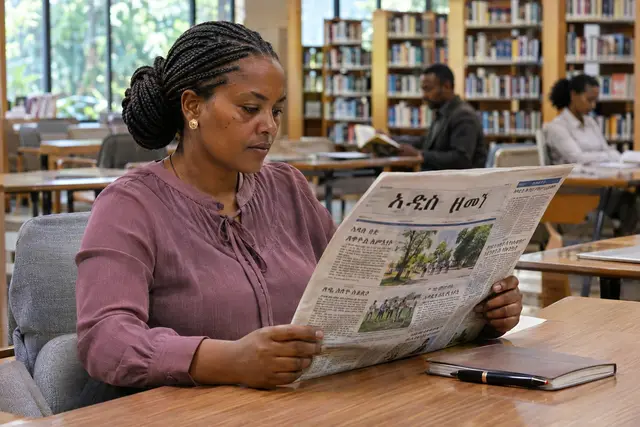
Bakalecho is a regional newspaper in Ethiopia, recorded as a historical title of the Ethiopian Press Agency and written in Sidaamu Afoo, the language of the Sidama people of southern Ethiopia. A study of editorial policies in the Ethiopian media lists it as a weekly paper issued by the state press house, next to titles in Amharic, English, Afaan Oromo and Arabic. Every issue is set in Sidaamu Afoo, never in English. Sources give no founding date, editors or circulation, so only language, publisher and rhythm are established.
What the sources establish
The firmest evidence about Bakalecho comes from a 2022 assessment of conflict sensitivity in the editorial policies of Ethiopian media outlets. In a table of the Ethiopian Press Agency, the paper appears as an entry in Sidaamu Afii, an alternative spelling of the language name, and it is mentioned a second time in the section that describes the agency's publications. Both mentions are short. They name the paper, its language and its weekly frequency, and nothing more.
That limit matters. No launch date, no named editor, no circulation figure and no website for the paper appear in the document, and no other source found while preparing this entry fills those gaps. Anything beyond the language, the publisher and the weekly schedule would be guesswork, so the sections that follow place the paper in the context that can be verified instead of inventing a biography.
The meaning of the name and the language of the paper
The newspaper carries a title in the language it is written in. The language is called Sidaamu Afoo by its own speakers, and it is also written Sidaamu Afii in some documents. It belongs to the Cushitic family of languages spoken in the southern highlands of Ethiopia, and it is the mother tongue of the Sidama people. The home region in the language is called Sidaamu Qoqqowo, which translates as the Sidama Region.
Readers who meet the title in English-language material should keep one distinction in mind. Language is the key point: the articles use Sidaamu Afoo, whereas the reference text about the paper is in English. A reader hoping to read the articles themselves needs to read Sidaamu Afoo in its Latin-letter spelling.
The meaning of the word Bakalecho is not explained in the sources consulted, and no translation is offered here, because an unverified gloss would risk misleading readers.
Sidaamu Afoo and its written form
A paper in Sidaamu Afoo is a relatively recent kind of publication, because the language has had a standard written form for only a few decades. Missionaries devised a system in Ethiopic letters in the 1930s to translate the Bible, and that system was used until 1993. Since 1993 the language has been written with the Latin alphabet, which is the script a reader will expect to find in a paper of this kind.
The language became a medium of instruction in schools of the Sidama area in 1994. Language specialists estimate that about four million people speak it, although only a minority of them were taught to read it in their mother tongue. That gap between the number of speakers and the number of trained readers is one of the main facts to consider when thinking about a newspaper written in the language: its natural public is larger than its practical readership.
Since the Latin script was adopted late, printed material in the language is modest in volume compared with Amharic. Each newspaper, textbook or radio script in Sidaamu Afoo therefore adds to a written tradition that is still being built.
The Ethiopian Press Agency as publisher
The Ethiopian Press Agency is the state-owned publishing house behind several of the country's best known newspapers. The assessment that mentions Bakalecho states that the agency was established in 1940 and that its editorial policy came into force in 2002. These are the dates given by that document, and they describe the publisher, not the newspaper.
The agency's flagship titles include Addis Zemen in Amharic, The Ethiopian Herald in English, Barissa in Afaan Oromo and Al-Alem in Arabic. Bakalecho appears in the same list as the paper in Sidaamu Afoo. Placing a Sidama-language weekly beside those titles shows an approach in which the federal press house offers papers in several national languages, not only in Amharic.
Because the paper is attached to a state publisher, its editorial line follows the policy of that publisher. The same assessment examines how the policies of such outlets deal with conflict, ethnic diversity and sensitive subjects, which is the background against which a state-published regional paper operates.
Weekly publication and what a weekly paper does
The sources describe Bakalecho as a weekly. A weekly paper works differently from a daily. It cannot compete with radio, television or social media on speed, so it normally concentrates on summaries of the week, explanatory articles, announcements of public institutions and features of lasting interest.
For a language community with a small reading public, a weekly rhythm is practical. It allows a small editorial team to prepare a full issue, and it gives schools, offices and libraries a regular title to follow. This describes the usual role of a weekly regional title. It should not be read as a description of any particular issue of Bakalecho, since the content of its issues is not documented in the sources found.
Information about its sections, its price, its number of pages or its print run was not found. These points remain unknown.
The Sidama Region and its place in Ethiopia
The Sidama people live mainly in the southern part of Ethiopia, around the city of Hawassa and the surrounding highlands. A referendum held in November 2019 approved the creation of a separate regional state, and the Sidama Region was established in 2020 as one of the regional states of the Ethiopian federation. Hawassa serves as its capital.
This political change gave new weight to the language. A regional state with its own government has an administrative need for texts, notices and news in the language of its population, and a paper in Sidaamu Afoo fits into that picture. The sources do not say, however, whether Bakalecho was created before or after the regional status, and no such link should be assumed.
The region is also known beyond Ethiopia for its coffee, and the Sidama New Year festival, Fichee-Chambalaalla, is a well known cultural event. Such subjects are natural topics for a regional paper, but the sources do not list them as subjects of Bakalecho.
Regional-language press in Ethiopia
Ethiopian press history long gave priority to Amharic and, to a lesser degree, to English. The introduction of federalism in the 1990s, with the principle that nations and nationalities may use their own languages, opened the way for newspapers, radio programmes and school books in other languages. Papers in Afaan Oromo, Tigrinya, Somali, Sidaamu Afoo and other languages followed in different forms, some run by the state and others by regional governments or private publishers.
The regional-language press faces constraints that are well known to researchers: small reading publics, limited advertising markets, the cost of printing and distribution outside Addis Ababa, and the need to train journalists who can write in the language in its standard spelling. A weekly such as Bakalecho should be understood against that background.
For Sidaamu Afoo in particular, the combination of a young written standard and a large spoken community makes each printed title important as a reference for spelling, vocabulary and style.
Press freedom and editorial context
State-published papers in Ethiopia operate in a media environment that has changed several times in recent decades, with periods of opening and periods of restriction. Research by civil society groups, including the study that lists Bakalecho, examines whether editorial policies protect independence and handle sensitive subjects responsibly.
For a paper linked to the Ethiopian Press Agency, readers should expect the editorial framework of a public institution. That framework affects which subjects are covered and how they are framed. The sources found do not evaluate the editorial content of Bakalecho itself, so no judgment about its coverage is offered.
Researchers who want to assess a regional paper in practice would need to read issues, compare the coverage with other outlets and consult the editors. None of those steps can be replaced by a summary, which is why direct access to issues is the best path for serious study.
How to find and read the paper today
No official website for Bakalecho could be confirmed. Anyone searching for issues should begin with the Ethiopian Press Agency, which publishes the paper, and ask about subscription, sales points and archives. In Sidama towns, bookshops, kiosks and offices of the regional administration may hold recent copies.
For older issues, the usual places are libraries and archives. The National Archives and Library of Ethiopia in Addis Ababa and university libraries, including those with strong holdings on southern Ethiopia, are the logical places to ask. Hawassa University, which has taught and studied the language, is another useful contact for researchers of Sidaamu Afoo.
When citing the paper, the title should be given as Bakalecho, with the language noted as Sidaamu Afoo, the publisher noted as the Ethiopian Press Agency and the issue date taken from the copy consulted. Dates should never be copied from secondary sources that do not show the issue itself.
Related titles and further reading
Readers interested in the neighbouring papers of the same publisher can compare Addis Zemen, The Ethiopian Herald, Barissa and Al-Alem. Each serves a different language public, and together they show how the same press house addresses several communities.
For the language, academic journals of Ethiopian languages and literature, including those of Addis Ababa University and Hawassa University, publish studies on Sidaamu Afoo grammar, orthography and literacy. The Omniglot reference on the Sidama writing system summarises the script history and the number of speakers.
Finally, the conflict-sensitivity assessment cited above is the source in which the paper is named. Its tables of Ethiopian media outlets remain the best starting point for anyone who wants to place Bakalecho among the other titles of the country's press.