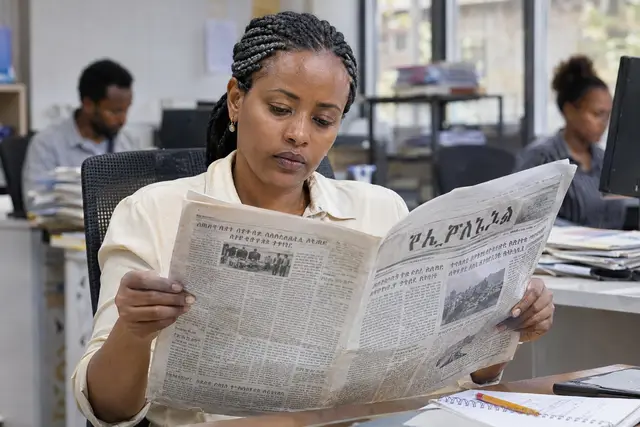
Ethiopian newspapers in Sidama Afoo language belong to the media of the Sidama, a people of southern Ethiopia centred on Hawassa, whose language Sidaamu Afoo is written in Latin letters. Published sources list almost no regular printed newspaper in the language, so the news reaches speakers mostly through radio, regional broadcasts, community media and national outlets in Amharic and English. Language research at Hawassa University and the creation of the Sidama regional state have increased interest in publishing in the language.
The Sidama people and their language
The Sidama live in the highlands and valleys of southern Ethiopia, around Hawassa and Lake Hawassa, and are known for coffee growing, enset cultivation and the Fichee-Chambalaalla New Year festival. Their language, called Sidaamu Afoo, belongs to the Cushitic family and is written today in Latin letters. It is the language of daily life, of local schools and of regional administration in the Sidama area.
Politically, the Sidama achieved a regional state of their own after a referendum in November 2019, and the regional state was formally established in 2020, with Hawassa as its capital. That change increased the public role of Sidaamu Afoo and raised hopes for more media in the language.
What can be established about printed newspapers
Available sources describe very few regular printed newspapers in Sidaamu Afoo. Standard lists of Ethiopian newspapers name titles in Amharic, English, Afaan Oromo and Arabic, but do not list a Sidama-language title, and academic guides to Ethiopian news sources focus on national and regional outlets in larger languages.
This does not prove that nothing has been printed. Local bulletins, school materials, church leaflets and administrative notices have probably appeared in small runs that were never catalogued. Statements about founders, dates or circulation should therefore be made only when a reliable source gives them, and in the case of printed Sidama papers the sources consulted do not.
Broadcasting and the Sidama Media Network
Broadcast and online media have done more for the language than print. Sidama Media Network, which had its offices in Hawassa and also had a presence in South Africa, was described by an activist quoted by the Committee to Protect Journalists in 2019 as a voice for the Sidama cause. The CPJ reported that security forces took the station's keys in July 2019 and that managers and board members were arrested, after which the station reopened within days.
The same report did not state in which language the network broadcast, so its exact linguistic profile should not be assumed. The episode shows the sensitivity of Sidama media during the years of the statehood campaign and the importance of a free press in a period of political change.
Community radio and local programmes
Academic work on community radio in the Sidama area discusses how local stations support socioeconomic development, broadcasting health, agriculture, education and cultural programmes. Community radio fits the oral character of the language and allows farmers and women to take part in discussions on matters that affect them.
Regional broadcasters also schedule Sidaamu Afoo programmes, and the standardisation of the language, supported by researchers at Hawassa University, gives presenters a reference for vocabulary and spelling.
Hawassa University and language standardisation
Hawassa University hosts an Institute of Sidama Studies, which works on indigenous knowledge, culture and language. According to a report on its public lecture on the orthography of Sidaamu Afoo, speakers debated whether the current writing system should be improved, including the question of using the Ethiopic script with modifications. The institute is also developing a monolingual dictionary and planning a cultural museum and library.
These projects matter for the press because newspapers depend on stable spelling and a shared vocabulary. A paper that must invent terms for modern subjects such as banking, technology or public health needs the backing of dictionaries and style guides, and the work of the institute provides a base.
Possible content of a Sidama-language paper
A newspaper in the language would naturally cover regional administration, coffee and enset farming, markets in Hawassa, schools and health services, as well as cultural events. Notices from administrations and cooperatives, and reports on festivals such as Fichee, would offer content of local relevance.
Because many readers know Amharic, English or both, a paper might publish bilingual pages. Short formats, such as one-page bulletins and radio scripts, are often a first step before launching a regular weekly.
Coffee, enset and the daily life reflected in local news
Rural life in the Sidama area revolves around coffee, enset, maize and livestock, and information on prices, seasons, disease control and cooperatives is what readers want most. Reports on the coffee harvest, on buyers at the Hawassa market and on agricultural training are typical content for a local bulletin.
Education and health also matter. Schools use Sidaamu Afoo in the early grades in the region, and health workers rely on local-language messages to explain vaccination, nutrition and sanitation. Material prepared for these services shows what written Sidaamu Afoo looks like in practice.
Festivals and memory
The Fichee-Chambalaalla festival marks the New Year and draws visitors to Hawassa. Photographs, songs and interviews with elders are recorded by local media and by researchers, who see them as part of the heritage of the Sidama.
Oral history is central. Elders pass on genealogies, laws and stories, and projects that record them in writing serve both the language and the future press by building a stock of texts that editors can draw on.
Languages used by Sidama readers
Sidama readers typically live in a multilingual environment. Sidaamu Afoo is spoken at home and in the community, Amharic is the federal working language and commonly used in business, and English is taught in secondary schools and universities. Readers move between them according to purpose.
News from Hawassa and the region is therefore found in several languages. A reader looking for information on the Sidama region can consult the Ethiopian News Agency in English and Amharic, national dailies, and local radio, while seeking Sidaamu Afoo content in broadcasts and community materials.
Press freedom and the regional context
Journalists in the south have worked under pressure, as the 2019 arrests at Sidama Media Network showed. Local media often depend on small budgets, limited training and the goodwill of authorities, which makes independent reporting difficult.
Researchers and readers should treat information about this sector carefully, check each claim against more than one source, and distinguish between what is documented by monitoring organisations and what is hearsay.
Challenges for a future Sidama press
Starting a newspaper in a language with a young written tradition demands trained editors, proofreaders and translators, plus printing facilities and a way to fund distribution. Advertising markets in a mainly rural region are small, so a title may need support from cooperatives, administrations or associations.
Digital channels offer a cheaper beginning. A website or a messaging channel can publish short news items in Sidaamu Afoo at little cost, test what readers want and train a team before attempting a printed edition. Such experiments would also generate texts that linguists can study.
Whatever the format, editorial independence will matter. Readers are more likely to trust a publication that publishes corrections, names its editors and separates reporting from advertising and from political messages.
How to follow Sidama news and publications
The most practical sources are the university institute, regional radio programmes, national news agencies with reports from Hawassa, and the studies available through Ethiopian university journals. For research, directly asking regional offices and cultural associations about printed material is more productive than relying on general catalogues.
A reader who wants to see Sidaamu Afoo in print can look for school books, grammar texts and religious publications, which are more numerous than newspapers and give a view of written usage.