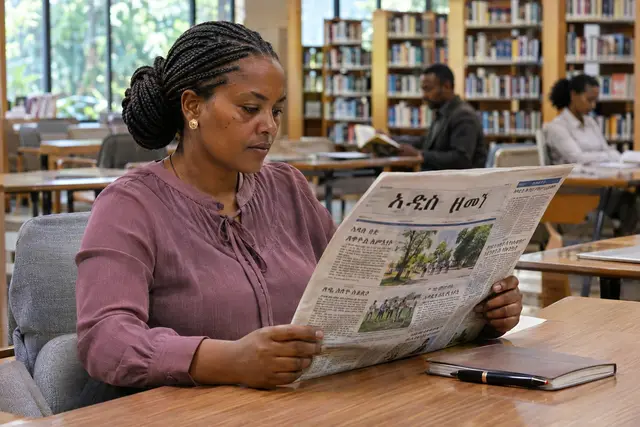
Addis Herald is a historical newspaper of Ethiopia, listed in an online directory of Ethiopian titles as an English-language paper with the web address addisherald.com. The address now leads to an empty page, and no catalogue consulted gives a founding year, a publisher, an editor or a closing date. It is distinct from the Ethiopian Herald, the state daily of the Ethiopian Press Agency. The record is thin, so its status, readership and years of publication are described here only as unconfirmed.
What can be established
Very little documentation survives for the Addis Herald, and it is better to say so plainly than to fill the gap with guesses. A well-known directory of online newspapers lists a title called Addis Herald among its Ethiopian entries, marks it as English-language and gives addisherald.com as its web address. That is the whole of the verifiable record.
A check of that web address shows only a blank redirect to a default hosting page, with no visible articles, no masthead and no about section. The site therefore offers no way to confirm who ran the paper, how often it appeared or when it stopped. Searches in library catalogues and news archives return the Ethiopian Herald of the state press agency, but no separate run of an Addis Herald.
The sources consulted give no founding date, no publisher, no editor and no circulation. None are supplied here.
The risk of confusion with the Ethiopian Herald
The most important point for a reader is the difference between this name and the Ethiopian Herald. The Ethiopian Herald is a documented English-language daily, started in the early 1940s and published today by the Ethiopian Press Agency in Addis Ababa. It has a long archive, is held in university libraries and is covered by African news aggregators.
The Addis Herald is not the same publication, and no source consulted treats it as an edition or a renamed version of the state daily. Entries that mention a Herald in Addis Ababa without further detail should therefore be read with care before they are attributed to one paper or the other.
Name overlap is common in Ethiopia. The capital's name appears in the titles of many outlets, among them Addis Zemen, Addis Fortune, Addis Standard and Addis Insight, and English words such as Herald, Monitor, Review or Gazette recur across the diaspora and the home press alike.
Why such titles are hard to document
Many small English-language titles of Addis Ababa came and went between the early 1990s and the 2010s. After the fall of the Derg in 1991, private publishing was legalised, and a study of the period counts more than 385 registered journals and newspapers by 1997. Few left a trace beyond a registration number.
Even the regulator's later figures show the pattern. The Ethiopian Broadcasting Authority registered more than 364 publications between 2009 and 2016, yet only nine private newspapers were active when researchers surveyed the field. A title can be real, legally registered and widely read for a few months, then vanish without any archive.
For an outlet in this situation, the useful question is not what its front page said but where its footprint can still be found: in directory listings, in deposit copies, in citations by scholars and in the memory of journalists who worked in the capital.
English-language readers in Addis Ababa
English is the language of higher education, diplomacy and much of the business world in Ethiopia, even though Amharic is the working language of the federal government and Afaan Oromo is the most widely spoken first language. A newspaper with Herald in its name and an English edition would have aimed at students, civil servants, hotel and airline staff, embassy employees and the many international organisations based in the capital.
That audience is concentrated in a few districts of Addis Ababa, which affects distribution. English papers sell mainly at hotels, bookshops, supermarkets and street kiosks around Bole, Piassa and Mexico Square, rather than through a national network.
The size of this readership is modest, and that explains why English-language outlets rely on advertising from banks, telecoms, airlines and development agencies. When an advertiser leaves, a small paper can fail quickly.
How to verify the title yourself
Anyone who needs firm facts about the Addis Herald should start from primary evidence rather than from web summaries. Useful steps include:
- Ask the national library and archives in Addis Ababa whether a deposit copy or a registration record exists under this title.
- Search the catalogues of African studies libraries, which often list Ethiopian periodicals with place, publisher and date range.
- Check the Internet Archive for captures of addisherald.com taken in earlier years.
- Contact Ethiopian journalists' associations, whose older members may remember the paper and its staff.
A confirmed publisher name, a year of first issue and a copy of one issue would be enough to turn this brief record into a full history.
Historical status
The title is treated as historical because no current publication under this name can be demonstrated. The website is empty, no recent articles are indexed and no news aggregator carries it. That is a statement about the evidence, not a statement that the paper never existed or that it closed in a particular year.
If the paper did publish regularly, its issues would be valuable to researchers of the private English press, which is thinly represented in archives compared with Amharic titles and with the state-owned dailies.
Until more evidence appears, the cautious description is a listed English-language title of Addis Ababa whose publisher, dates and fate are not documented.
Press freedom context
Titles in this category operated under a law that changed several times. The 1992 press proclamation, number 34/1992, opened the field. The 2008 law, number 590/2008, introduced large fines for defamation and was criticised as restrictive by the Ethiopian researchers who analysed it.
Journalists left the country in two main waves, one after the clampdown of the late 1990s and another after the 2005 election crisis, when several outspoken papers closed. Small English-language titles aimed at expatriates were not always targeted, but they were exposed to the same economic pressures, including newsprint shortages and the cost of printing.
Reading directories with care
Online directories of newspapers are compiled by small teams that copy entries from one another, and a listing can survive long after a paper has stopped printing. A directory entry proves that someone once recorded the title, not that the paper is alive. For the Addis Herald the entry confirms an English-language label and a web address, which is a starting point and nothing more.
A second habit is to compare spellings. Ethiopian names are transliterated in several ways, and an English title may be rendered with or without the word The, with Herald, Harald or Heralds in older typed records. A search that tries each variant, and that also tries the Amharic name if the paper had one, is more likely to find archive references than a single query.
Finally, dates matter. Whenever a source gives a year, it should be noted together with the page where it appears, so that later researchers can check it. Until such a date is found for this title, any claim about its age would be unsupported.
Related outlets
For documented English-language reading from Addis Ababa, the Ethiopian Herald offers state coverage, while Addis Standard and Addis Fortune give independent reporting. For a view of the wider field, a directory of Ethiopian newspapers online lets readers compare languages, cities and web addresses in one list.
Researchers who meet the name Addis Herald in an old bibliography can use those outlets to test whether a reference actually belongs to another paper.